Ways of Seeing
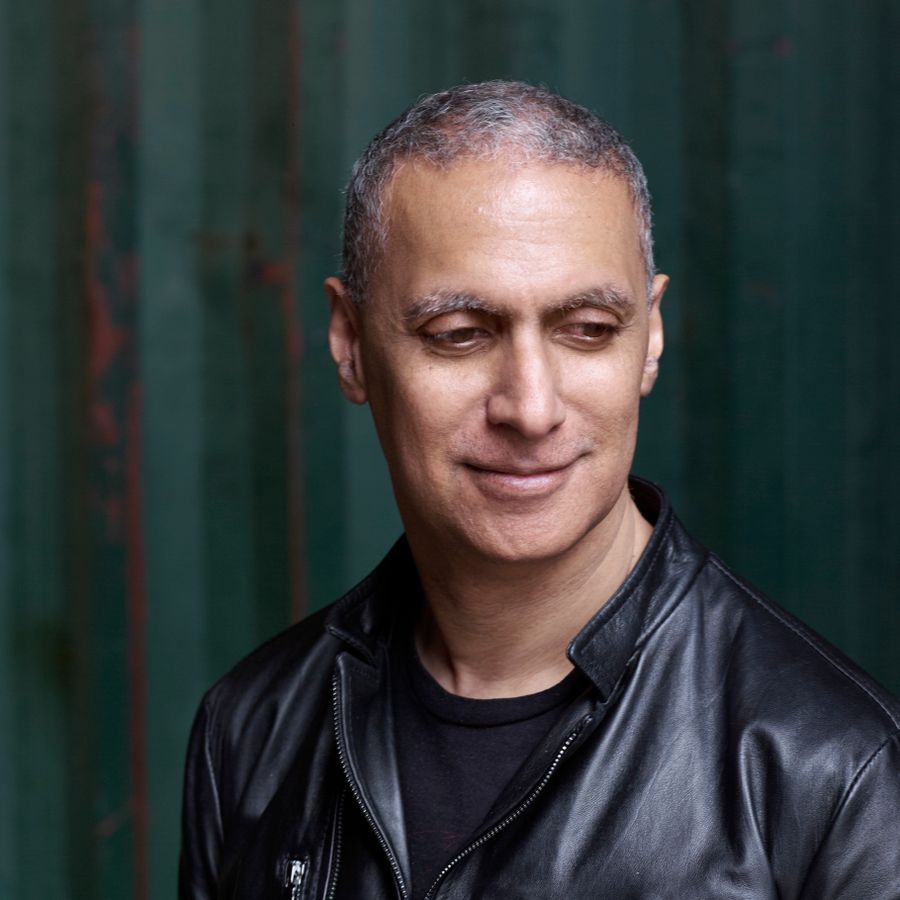
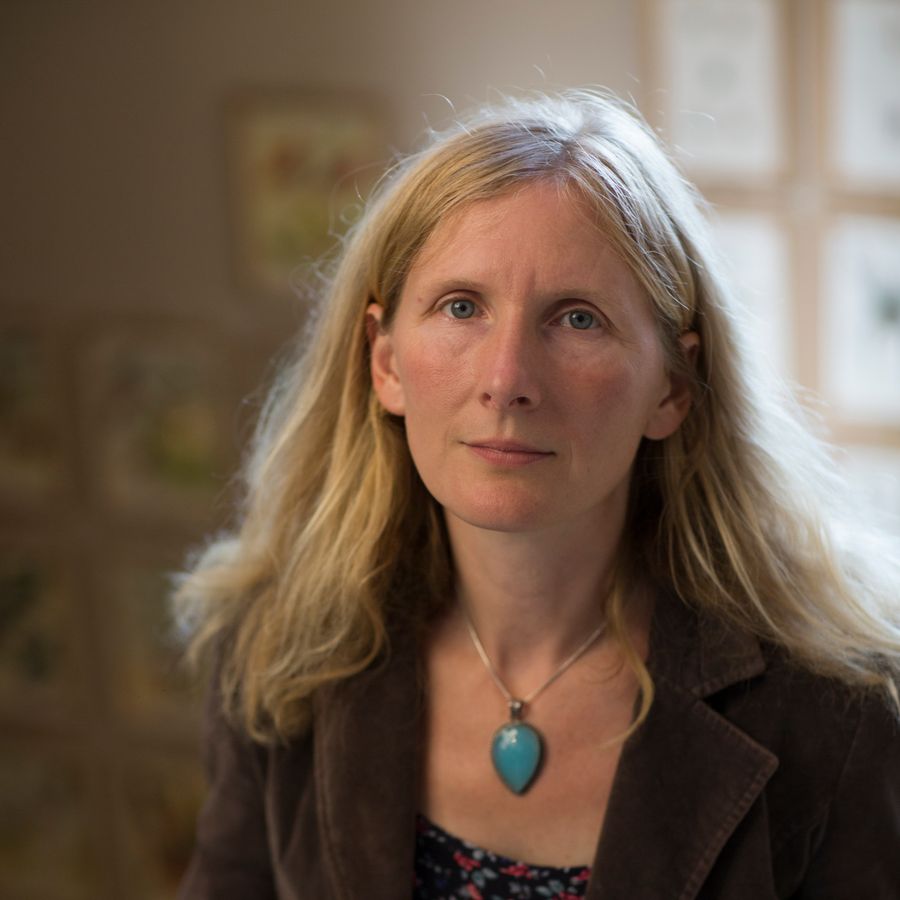
Award-winning composer and musician Nitin Sawhney has joined forces with celebrated author Samantha Harvey for a powerful new commission, Orbiting Orbital. Here they discuss how seeing the world from afar changes our perspective on life…
How does stepping back from something help us to understand it better?
Samantha: When I was writing Orbital, being able to zoom out, albeit only on YouTube videos, not in fact going to space, did give me a sense of where we live, of the context of our planet, of us as a species. It helped me to feel more compassionately towards humans in a way that I find quite difficult day to day.
But it isn’t everything. We have to zoom in as well, and often the very zoomed in and the very zoomed out are not so different. If you zoom out and look at something from afar, it enables you to gather a certain set of feelings and thoughts but those things can’t really be made meaningful in our lives unless we zoom back in again.
Nitin: I find it very helpful to be reminded of the value of our planet and given a perspective on that, and Samantha’s book and this project are really great reminders of the cohesion, the value, the beauty, the elegance of the planet that we’re on, especially when we live day to day in a very zoomed in version of reality. It’s quite refreshing to be able to step back and look at everything with a sense of wonder rather than constantly feeling like we’re in a downward spiral.
S: But there’s a danger that the zoomed out view can be a bit too romanticised. People can look at the earth from space and believe ‘we’re all in this together’ but actually, on the ground, we’re not all in this together – some people are in it much more than others. It’s a much more perilous world for some; a much more unjust world. We mustn’t lose sight of that when looking at the earth from space. This idea that it’s boundaryless and borderless – there’s an idealistic equality there but there isn’t equality on the ground.
N: I totally agree. I do feel quite overwhelmed with the political landscape, the lack of humanity and the perspective we gain from stepping back sometimes - which just reminds us of our common ancestry and our common beliefs and feelings, rather than constantly being divided by people who have interests to serve that don’t coincide with ours.
How can music as a medium convey such ideas in a way that words can’t, and vice versa?
N: Music is an inherent language of the universe; it is very much part of the fabric of our reality. I’m always trying to find a connection with the consciousness of the universe that is best for me expressed through sound and the taming of sound.
“So much of the arts and our enjoyment of the arts is about losing ourselves to find ourselves. Literature and music do that equally in different ways.”
S: My theory is that all art forms are really in service to music – music is so much embedded in us, in our heartbeats, in the rhythms of our bodies and our lives. I feel that other art forms are always chasing music, and that’s what I’m doing when I write most freely; there’s a rhythm to it, a kind of musicality to it. A piece of writing is working when it feels like music.
There isn’t a place that music can go that words can’t, or vice versa. But they get there through very different means, and that’s part of the beauty of it – and part of collaboration is finding different ways into similar feelings and into ourselves. So much of the arts and our enjoyment of the arts is about losing ourselves to find ourselves. Literature and music do that equally in different ways.
N: I really enjoy working right across different mediums and trying to find common vocabularies with people from different disciplines that can lead to something that feels fresh. I write lyrics as well because I get to a point where I can’t find the feeling I want to capture, due to the limitations I have as a writer of prose. I then have to put it into lyrics or poetry or some other form that I can work more easily with musically.
The grammar of expression and the form of expression should never supersede the expression itself; it should always be a vehicle for that. Ultimately, that’s all we’re doing: we’re trying to find the most fitting vehicle for our feelings.
Has collaborating on Orbiting Orbital changed the way you see ideas about distance and connection and what it means to belong?
S: It’s just deepened an instinct I already had around how amazing humans can be when we do things together. There is a depth of shared experience and shared feeling that the arts explore in a way that almost nothing else does.
Being able to focus on this project and on what other people bring to it, and the ways that other artists and academics enrich something feels unbelievably meaningful to me – to be able to pursue that commonality rather than be always distracted by the horrors of the world and the things that we don’t do well together.
N: You grow from every encounter with another artist, particularly if you’re collaborating with them. But in the first instance, I really responded to Samantha’s book. It was movingly cathartic without being didactic in any way.
What’s been beautiful about this process and working with Samantha, and with Antony Gormley and Mary McCartney, is that it all feels very respectful, but at the same time, we all have a very obvious curiosity about each other’s work and processes, and I think that shows.
How do you want the audience to feel?
S: You don’t have to set out to change minds. Just increasing the amount of joy and happiness and beauty in the world is enough in itself.
N: For me, it’s actually leaving the audience with a sense of resonance. If there is something that stays with people that makes them perhaps question something that they may not have questioned before, then that would be enough.
Do you think achieving different perspectives will help people to imagine a more connected future, even a more hopeful future?
N: I wouldn’t want to create a utopian version of anything. It shouldn’t be about people suddenly saying, ‘Oh, well, I can forget about all the troubles of the world and just look at these lovely pictures and hear some beautiful words and music’. Alluding to a kind of utopian future would be a distraction from the important shit that needs to be dealt with and thought about across the planet.
S: Sometimes when I was writing and I looked at images of the earth from space, I would feel hopeful and I would see our connectedness. And other times I just felt more despairing than ever: we’re not connected. Have we ever been?
As Nitin has said, this isn’t about drifting off into space and allowing people to just feel fine about things. It’s an invitation to a multitude of different possible thoughts and feelings that everyone involved in Orbiting Orbital can’t anticipate or prescribe in any way.
How might the experience of seeing earth from afar influence how people consider climate change and the planet’s vulnerability?
S: If anything is a call to action, it’s that vulnerability of ‘us’, not of the planet, and the fact that there are no other happy alternatives. This planet corresponds to all our notions of heaven: light filled and abundant and liveable. That’s what I most take from those zoomed out images of the earth: this is heaven.
N: There are a lot of answers to our problems in listening to what is around us and responding in a way that is harmonious and thoughtful and connected. In writing the music for Orbiting Orbital, that’s something I’ve been thinking about a great deal.
Is listening becoming harder to do in such a hectic world?
S: I think certainly attention is something that we lack. To attend to something – in that sense of abiding, waiting and really tuning in – is something we’re not that good at as a species, or at least we’re not good at it anymore, if we ever were.
But writing, making music, making art is a form of attention and of listening and of looking – that is inherently what we’re trying to do, and maybe it’s what we need to do more in our lives; our gaze is very scattered.
N: Our attention is saturated with information and disinformation all the time, to the point where now we cannot really tell the difference between truth and fiction, and it’s very hard for us to find what is meaningful.
It’s very difficult to figure out where to place your attention at the moment, and that’s why, for me, a book like Orbital coming along is a fantastic reminder to be able to step back and say, ‘Let’s just take a moment and breathe and look at what we have’.
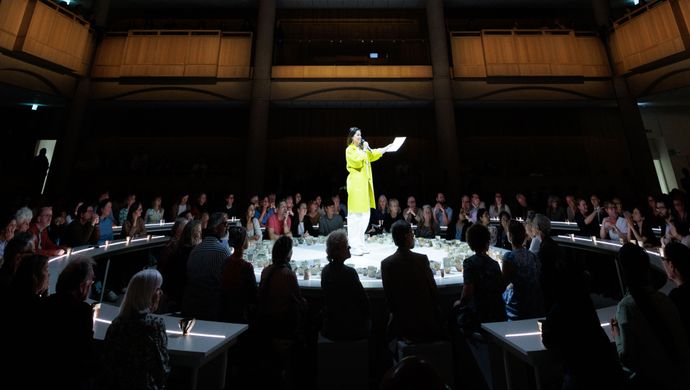
Inspired by Harvey’s Booker Prize-winning novel, Orbiting Orbital features six new poems by Harvey, accompanied by six new pieces of music and a special new cantata composed by Sawhney. In addition, Antony Gormley has contributed six specially selected drawings and the project will also feature photographs by Mary McCartney. Showing at the Schwarzman Centre from 6 – 7 November 2026.