The spaces in between
Has technology changed our ability to pay attention or simply shifted what we pay attention to?
Kathryn Eccles, Associate Professor and Senior Research Fellow at the Oxford Internet Institute (OII), was walking through a French city with her fourteen-year-old daughter recently when she realised she’d left her phone behind. She hadn’t noticed for almost an hour. There had been no photographs, no checking of the map, no message alerts to jar her back to reality – just a long conversation and the pleasure of getting slightly lost.
Mobile technology is woven into our daily lives, shaping how we experience the world – from sharing photos and videos to checking directions and looking up facts. Our attention can feel increasingly fragmented, pulled between screens, conversations, notifications and our immediate environment.
But Laura Tunbridge, Heather Professor of Music, University of Oxford, believes that we’ve always been distracted, albeit by ever-changing distractions. “It’s more a question of what we choose to pay attention to, and why,” she says.
She cites the philosopher Theodor Adorno, who studied radio listening. “In a 1965 lecture he talks about schone Stellen, or beautiful passages of music, and the idea that we tend to pick out fragments of music – the good bits of the tune that we’ll remember and hear repeatedly because they will emerge from the texture of the soundscape.”
Early gramophone records forced entire operas into short segments; Tunbridge recalls someone describing a childhood spent turning over records for his grandfather every few minutes to play an entire Wagner opera. “In a funny way, you could say it’s really fragmenting it but, on the other hand, if you’re sitting there attentively putting the record on all the time, then you’re doing a really deliberate kind of listening.”
Tunbridge also debunks the myth that carefully curated vinyl and CD albums are a ‘traditional’ way of listening that has been disrupted by streaming technology. She points out that concerts in the 19th century deliberately mixed genres because audiences valued variety over coherence. “There’s a particular kind of modern sensibility which is encouraged by technology in the LP era,” she says – the idea that an album should build into one coherent whole.
The art of paying attention, of listening, has always faced new challenges, but perhaps the more significant change isn’t that technology has fragmented our attention, but that it has claimed the spaces in between – when we’re waiting for a bus or a friend, for example. These moments can create space for us to ponder the bigger questions in life; to let our minds roam.
“Boredom is really positively associated with creative thought.”
“ I was really struck that I hadn’t noticed until our furthest point on the walk that we didn’t have the technology we would normally draw on at least every five minutes.”
“That’s where technology has really taken up space,” says Eccles. “Boredom is really positively associated with creative thought.” She gives the example of her childhood summer holidays when nothing was scheduled: “You had to get really creative and find something to occupy your mind.”
These moments today are often claimed by social media feeds; a temptation to scroll trumps the impulse to reflect. Eccles says we pay less attention to our immediate environment, such as the route we choose to walk to the shops or the sights on the bus journey, as we reach for our phones. “We’re not always so keenly aware of the analogue behaviour that’s being replaced by digital technology.”
“Hearing and sensing how everyone around you reacts to a performance is as much a part of going to the theatre as the show itself.”
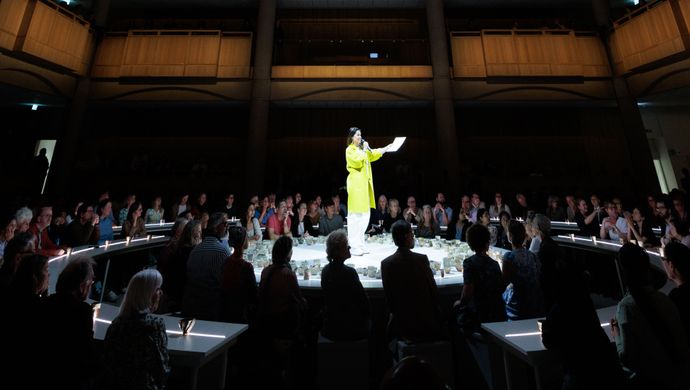
Perhaps this is why moments of shared, sustained attention can feel even more meaningful. Alex Coke, Theatre and Performance Partnerships Manager at TORCH (The Oxford Research Centre in the Humanities), has worked in theatre her whole life.
She remembers going to a production for the first time after Covid lockdowns lifted: “That feeling of shared concentration was so moving to experience again after so long.”
A live audience does something a screen can’t: “Hearing and sensing how everyone around you reacts to a performance is as much a part of going to the theatre as the show itself.”
But audience behaviour has changed, with more phone interruptions and noise complaints. Coke is phlegmatic, positive even about the impact of this on creators: “I think it’s encouraging the sector to innovate and create work which is genuinely fresh and original and exciting. I also think it’s an opportunity for theatre to really pave the way, to carve out these shared experiences as spaces where we say, ‘leave the outside world at the door for two hours’.”
Does it mean that structured, shared moments of prolonged attention such as watching a play or a concert matter more than ever? As Eccles says, “The power of the face-to-face, of encountering something in real life and having a physical, emotional reaction because you’re in front of it – we absolutely have to hang on to that.”
But it doesn’t have to be either-or. Eccles says, “Technology can support that, amplify it, and be a part of it, as long as we’re tuning into the real as well.” Next time you’re waiting for a bus or mid-conversation as a message buzzes on your phone, what will win your attention?