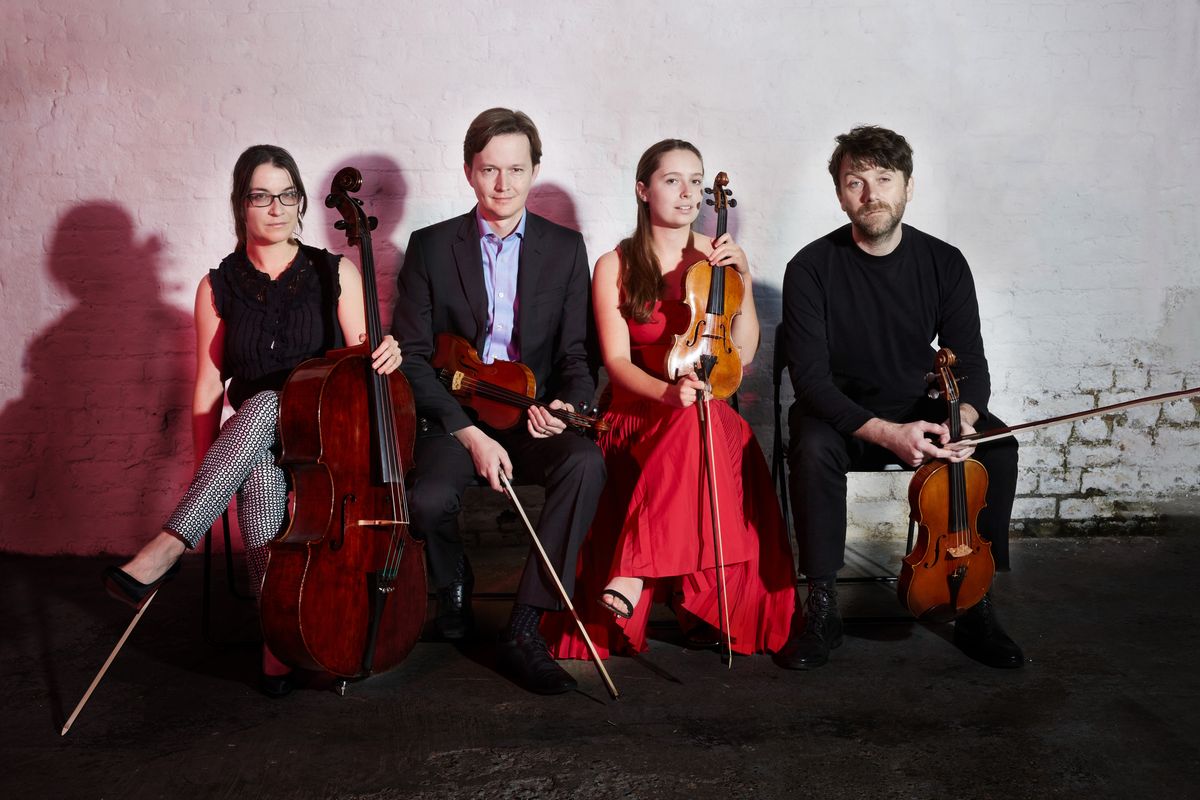
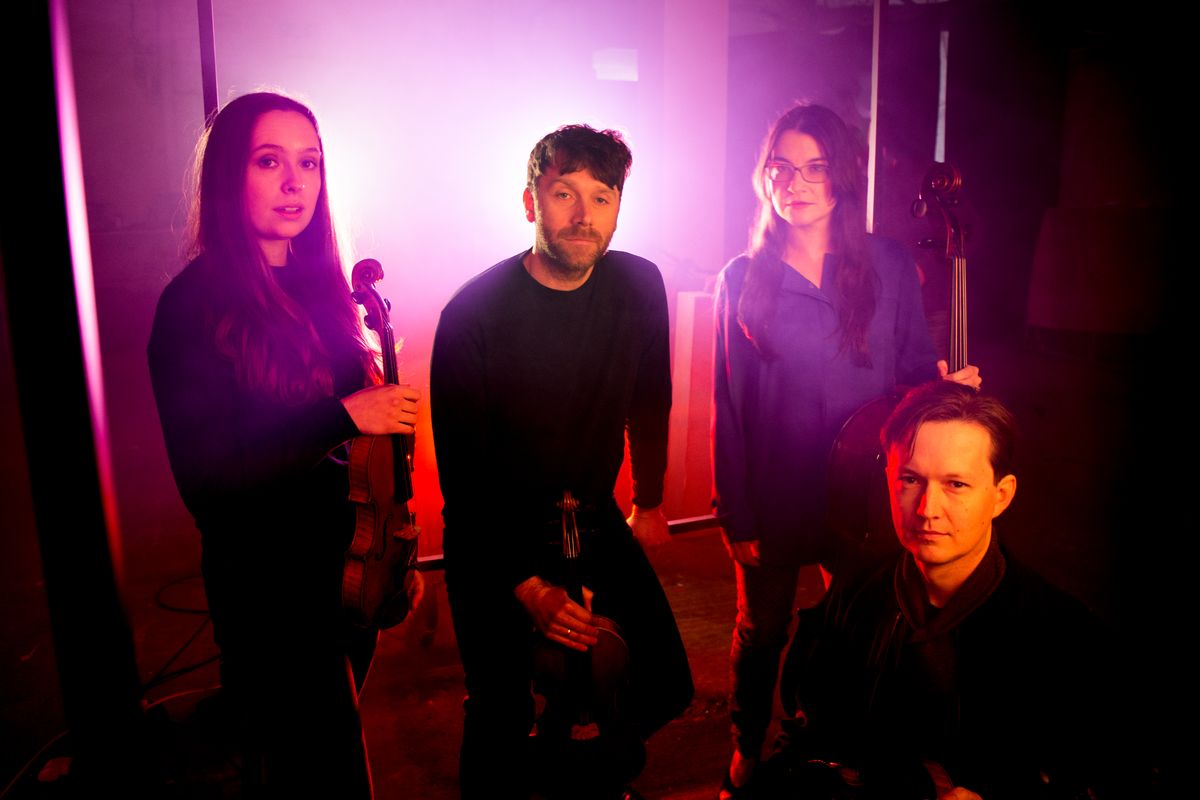
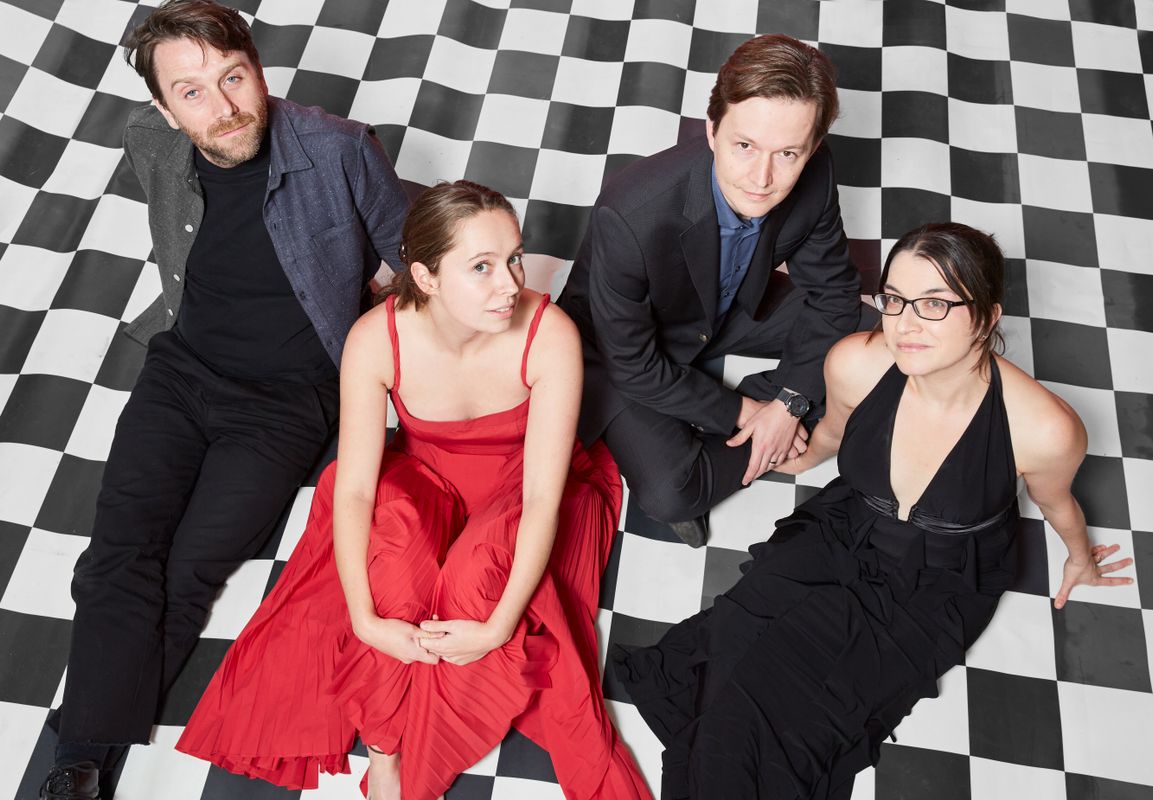
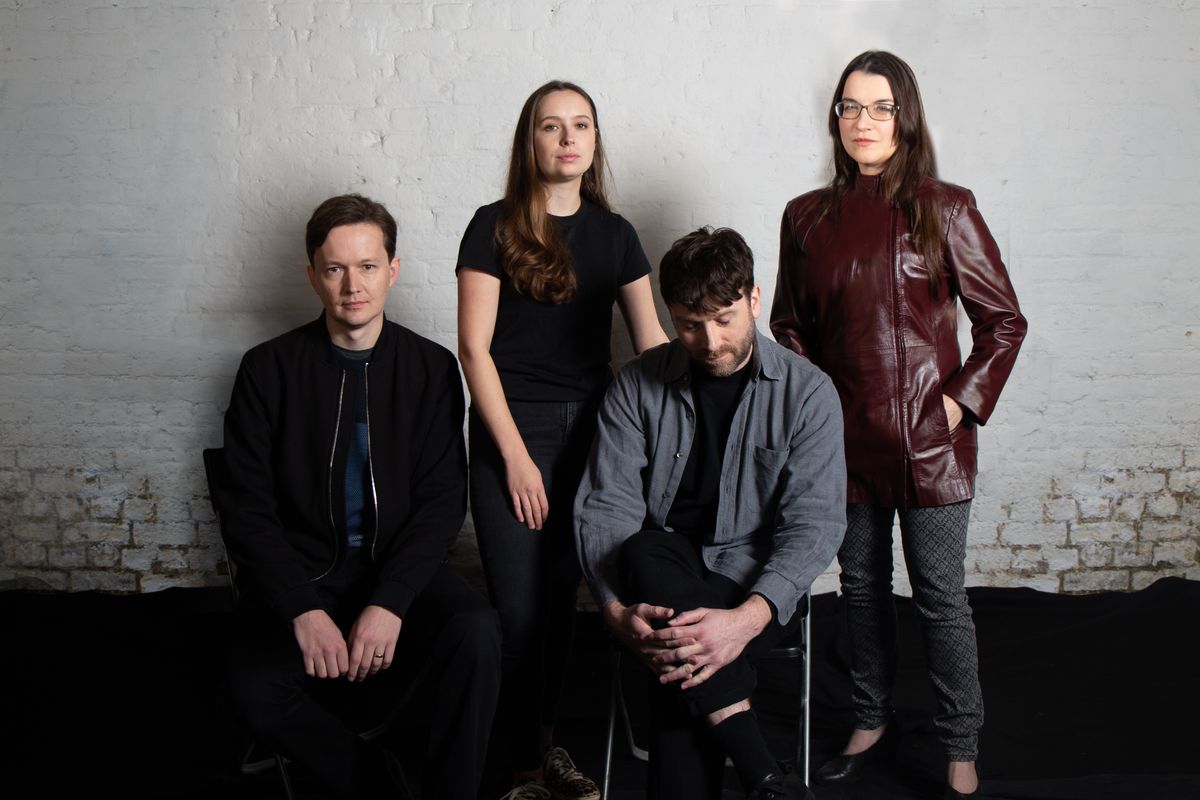
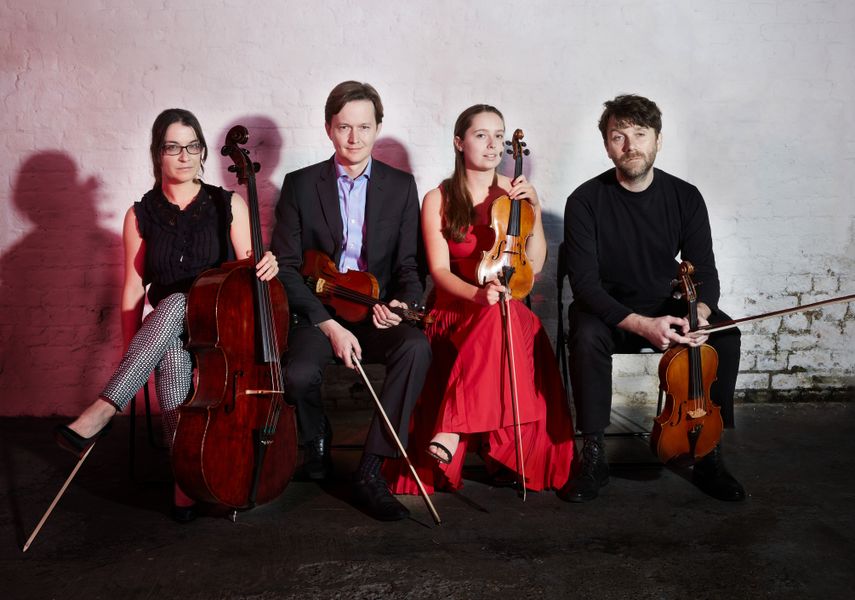
Propulsive, elegaic and affecting music, performed by a world-renowned string quartet.
Steve Reich’s Different Trains is one of the defining works of the late 20th century, earning the composer a Grammy Award for Best Contemporary Composition in 1989 and inspired by the train journeys Reich took as a child across the United States during the Second World War.
Fragments of speech from train conductors, Holocaust survivors and Reich's governess are interwoven with live strings, creating a haunting sonic tapestry. For this performance, the tape track has been remastered for spatialised sound, animating it with a vividness beyond what listeners may previously have heard, and brought to life alongside the Ligeti Quartet.
Alongside it is Justė Janulytė’s Circle for a Square, a reimagining of a work originally conceived for four string quartets that plays with the sense of space and time, and Reich's Triple Quartet, a three-movement work of exhilarating momentum and intensity, written for three string quartets.
Three different journeys, with the groundbreaking Ligeti Quartet as bold and brilliant guides.
Part of Steve Reich in Focus, a series celebrating the 90th birthday of one of the most influential musical minds of our time.
Performers
Freya Goldmark violin 1
Patrick Dawkins violin 2
Emma Purslow viola
Val Welbanks cello
Repertoire
Steve Reich Triple Quartet
Justė Janulytė Circle for a Square
Steve Reich Different Trains
Download programme notes as PDF
Programme notes (click to expand)
Triple Quartet
Triple Quartet is for three string quartets. For Kronos (or any other single string quartet) to perform the piece they must pre-record quartets two and three and then play the quartet one part along with the pre-recorded tape. Alternatively, the piece can be played by 12 or more string players with no tape.
The piece is in three movements (fast-slow-fast) and is organized harmonically on four dominant chords in minor keys a minor third apart: E minor, G minor, B-flat minor, C-sharp, minor, and then returning to E minor to form a cycle. The first movement goes through this harmonic cycle twice with a section about one minute long on each of the four dominant chords. The result is a kind of variation form.
Rhythmically the first movement has the second and third quartet playing interlocking chords while the first quartet plays longer melodies in canon between the first violin and viola against the second violin and cello.
The slow movement is more completely contrapuntal with a long slow melody in canon eventually in all 12 voices. It stays in E minor throughout.
The third movement resumes the original fast tempo and maintains the harmonic chord cycle, but modulates back and forth between keys more rapidly. The final section of the movement is in the initial key of E minor, and there the piece finally cadences.
Triple Quartet was commissioned by and is dedicated to the Kronos Quartet.
— Steve Reich
Ligeti Quartet: Justė Janulytė, Circle for a Square
The Ligeti Quartet presents a re-imagining of Justė Janulytė’s 2018 work for four string quartets, Circle for a Square. In the original, the groups are placed around the audience, forming a square, whilst the music moves in circular patterns, gradually expanding the sphere in a sense of range, texture and dynamics. In this version, the Ligeti Quartet will perform amplified with three pre-recorded layers played back in quadraphonic speaker formation.
Janulytė describes her music as ‘monochrome’ and her works can be thought of as sonic objects, with colour, density, shape and temperature which slowly evolve over time, bringing together minimalist aesthetics and a spectral soundworld.
Circle for a Square is subtitled with a line from Paul Valéry’s poem Poésie (1920), “Je touchais à la nuit pure”.
Different Trains
Different Trains, for String Quartet and pre-recorded performance tape, begins a new way of composing that has its roots in my early tape pieces It’s Gonna Rain (1965) and Come Out (1966). The basic idea is that carefully chosen speech recordings generate the musical materials for musical instruments.
The idea for the piece came from my childhood. When I was one year old my parents separated. My singer, song writer mother moved to Los Angeles and my attorney father stayed in New York. Since they arranged divided custody, I travelled back and forth by train frequently between New York and Los Angeles from 1939 to 1942 accompanied by my governess. While the trips were exciting and romantic at the time I now look back and think that, if I had been in Europe during this period, as a Jew I would have had to ride very different trains. With this in mind I wanted to make a piece that would accurately reflect the whole situation. In order to prepare the tape I did the following:
- Record my governess Virginia, then in her seventies, reminiscing about our train trips together.
- Record a retired Pullman porter, Lawrence Davis, then in his eighties, who used to ride lines between New York and Los Angeles, reminiscing about his life.
- Collect recordings of Holocaust survivors Rachella, Paul and Rachel, all about my age and then living in America— speaking of their experiences.
- Collect recorded American and European train sounds of the ‘30s and ‘40s.
In order to combine the taped speech with the string instruments I selected small speech samples that are more or less clearly pitched and then notated them as accurately as possible in musical notation.
The strings then literally imitate that speech melody. The speech samples as well as the train sounds were transferred to tape with the use of sampling keyboards and a computer. Three separate string quartets are also added to the pre-recorded tape and the final live quartet part is added in performance.
Different Trains is in three movements (played without pause), although that term is stretched here since tempos change frequently in each movement. They are:
- America—Before the war
- Europe—During the war
- After the war
The piece thus presents both a documentary and a musical reality and begins a new musical direction. It is a direction that I expect will lead to a new kind of documentary music video theatre in the not too distant future.
— Steve Reich – 1988