


Bringing together Earth Science and performance, Megalith explores our complex relationship with mining and the materials that shape modern life. Professor Jon Blundy, Royal Society Research Professor in Earth Sciences, reflects on his collaboration with theatre company MECHANIMAL, the creative possibilities of bringing research into cultural spaces, and how the arts can open up new ways of thinking about some of the challenges facing society today.
Could you tell us about your involvement in Megalith, and how you came to work with MECHANIMAL on the project?
Before I came to Oxford in 2020, I was at the University of Bristol, where I started an initiative called Earth Art. It was designed to develop collaborations between local artists and researchers in Earth Sciences in Bristol. There’s a vibrant art scene there, and Earth Art ran for quite a few years before I left.
While it was running, Tom Bailey from MECHANIMAL got in touch. We did mostly visual arts through Earth Art, but also some audio art, and he wondered if we could do some performing art. We had lots of conversations about how that might work, and he invited me to see some of his work with MECHANIMAL, including Vigil at the Old Vic in Bristol.
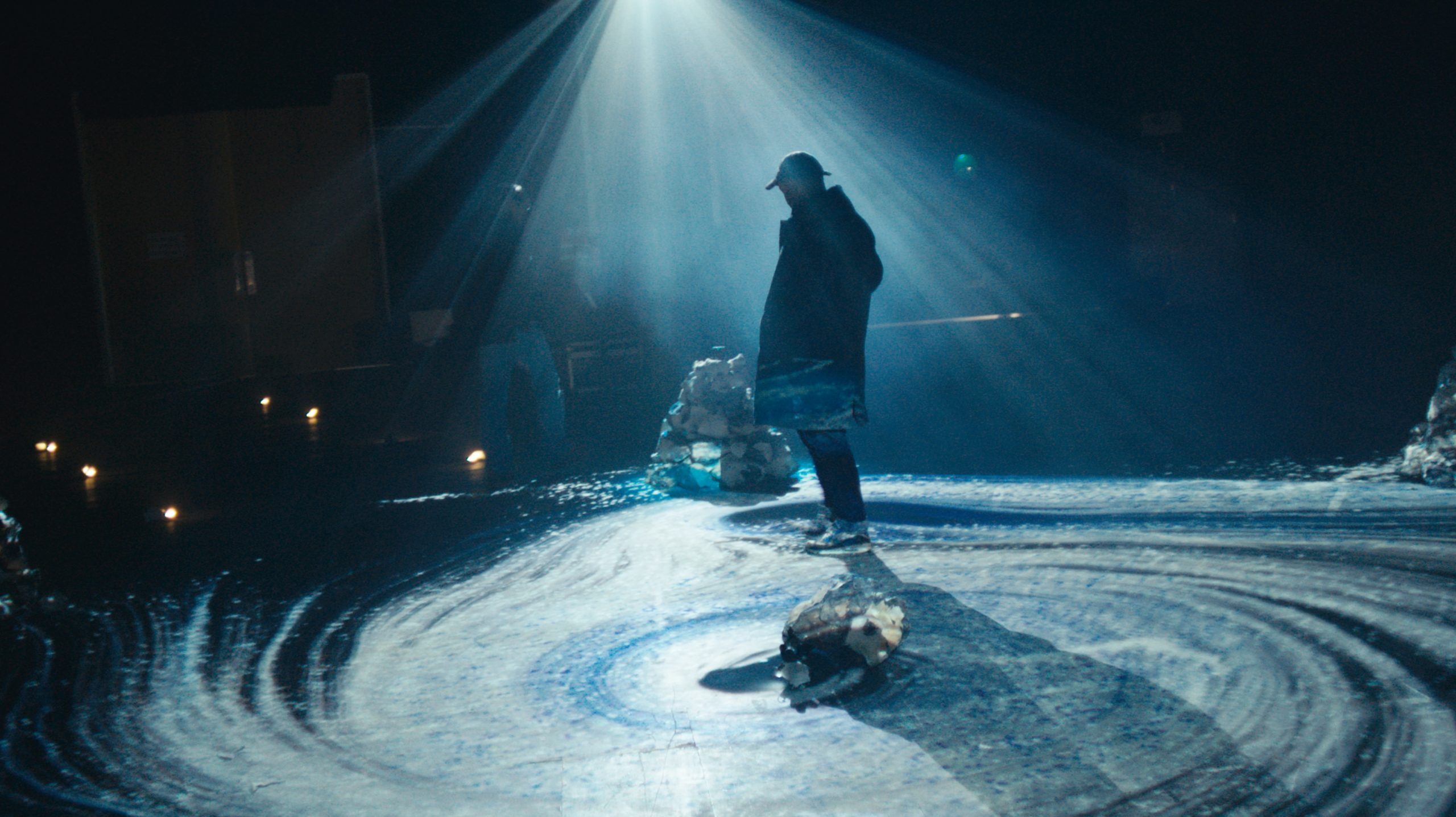
We talked about doing something around mining — a piece of theatre around mining — and when I moved to Oxford, we continued that collaboration. Tom produced Megalith, which was first shown at the Oxford Ideas Festival in 2022, and I provided some funding for that. It was performed in the OVADA space near the railway station. It was very powerful, and we thought it would be interesting to try it in a different space and reach a slightly bigger audience.
I then learned about the TORCH funding scheme. Tom and I put in an expression of interest in 2023, and in 2024 we got the funding to try something quite ambitious: putting a piece of theatre and some installation art in the Oxford University Museum of Natural History.
The OVADA performance was in an industrial space, with loud music and a lot of sensory impact. The museum is obviously a different setting, so it will be interesting to see how Megalith works in that space.
What interested you most about collaborating on a project that explores rocks and mining through theatre, sound and installation?
A lot of my research looks at natural resources, and when you step back and take a global perspective, it’s very clear that we all rely on critical raw materials for our everyday lives.
In parts of the world where there is mining, people understand where resources come from. But in the UK, we’re so divorced from the source of material. I think most people have no idea that there are holes in the ground and other sorts of excavations that produce the metals we use every day.
We often find that people in Britain would say they dislike mining - they don’t want anything to do with mining, and it must never happen anywhere near them. That’s at odds with the fact that we are very reliant on the products of mining.
Tom and I thought we might be able to use theatre as a way to challenge people’s perceptions, and to get them to think about: What is our relationship with mining? Why do I dislike it? How can I reconcile my dislike with my dependence on it? We thought theatre was a great way to do that.
Tom’s previous show, Vigil, explored extinction and extinct species in a powerful way, and it made me think that bringing a similar creative approach to raw materials could be really interesting.
At the time we first had the conversation, I was working on copper mining, and that’s why copper features in Megalith, the performance. But the installation is about more than just copper; it also looks at some of the other metals that are critical.
I’d like people to come and see Megalith and, on one level, just be wowed by the visuals and the music in particular, but also to go away thinking: what is the deal with mining? Is there a way of getting the resources we need without simply relying on other people to have holes in the ground?
Are there any aspects of your research that you were particularly keen to bring into the creative process?
An interesting thing I’ve learned from working on natural resources is that there’s one part of the challenge that you could call technological: finding the resources, recovering them, fashioning them into the products that we make, ensuring that local people are suitably remunerated for their assets, and looking at secure supply chains. We’re very reliant on certain countries for certain raw materials, particularly China. That’s one aspect — the technical aspect.
The other aspect, which is just as important, is social licence: having people understand that if we want to embrace a net-zero or low-CO₂ world, and if we want to have technological advances, we are going to have to engage with mining.
That’s the tension - certainly in Europe, and in Britain in particular, we’re really looking the other way, when some big natural-resource challenges are facing us.
What do you hope audiences might come away thinking differently about after experiencing Megalith?
Megalith starts very much at the beginning. As humans, we’re locked into mining and resource extraction. We have the Iron Age and the Bronze Age, and all of human development is linked quite closely with the extraction of raw materials.
The scale has changed and the materials have changed, but the processes that meant we got iron and copper in prehistoric times haven’t changed a great deal. Our lives are inextricably linked to resources.
But as individuals, we’ve become more and more divorced from that. It’s a bit like how we no longer have much idea where the food we eat comes from - many people probably wouldn’t know what a quinoa plant or an avocado tree looks like.
We are separated from these things, and I’d like people to appreciate that that separation is, in some way, a choice — and that we can’t just keep looking the other way. I don’t mean we have to stop using things; it’s more that we do need to think about it.
I’d also like there to be a Q&A with the audience. We’ve found that can be quite provocative, because people do have strong opinions about these topics. I’d like the museum to be a forum for an exchange of ideas.
What do you think the arts can bring to the way scientific research is communicated and understood?
I do think that theatre is an underexplored medium for science communication. It’s something we [as scientists] don’t use as much as we might. You can hold someone’s attention for some time in the theatre, so there’s a real opportunity to do more with performing arts for sharing ideas, stimulating dialogue and encouraging people to move out of their comfort zones. I’d like to see greater recognition of the performing arts as a way of communicating research, with more opportunities for science funding to support collaborations of this kind.
As well as what people will get immediately from the experience of Megalith, it would be great if more of us scientists could work with theatre companies like MECHANIMAL. Science communication can so often be the talking head, the scientist in a lab coat, but sometimes you want a slightly different way of reaching people and sharing ideas.
Megalith comes to the Oxford University Museum of Natural History from 24–31 October 2026, bringing together performance, science and immersive installation to explore our relationship with the materials that shape our world. Discover Megalith and book your tickets.