5 Minutes With...Cultural Fellow Anna Clyne and Jody Elff
24 Feb 2026
Composer and Schwarzman Centre Cultural Fellow Anna Clyne and sound artist Jody Elff were in residence at the Schwarzman Centre this month for the second stage of a three-part development process for their new work, Looking Glass. Inspired by the magic of author Lewis Carroll, the piece will premiere at the Sohmen Concert Hall in June 2026 as part of Unfinished Revolutions.
Written for string quartet, ensemble and their collaborative project, the Augmented Orchestra, Looking Glass brings together Clyne’s orchestral composition practice with Elff’s innovative approach to music technology. In conversation, they share the origins of the work, their long-running collaboration, and their experience of working with student musicians from Oxford University’s Faculty of Music as they continue shaping the piece.
You’ve been building the Augmented Orchestra together for several years now. How did this collaboration begin, and what sparked the idea to merge orchestral writing with contemporary music technology?
Anna: Looking Glass, which is the piece we’re developing here at the Schwarzman Centre, is our fourth piece for the Augmented Orchestra. The process for the Augmented Orchestra started back in 2017 in my apartment in Brooklyn, over a bottle of wine, talking about how we could bring our artistic endeavours together — my background in orchestral music composition, and Jody’s decades-long experience in music technology.
Jody: The observation was that while the orchestra is still a vibrant music-making entity, its basic form hasn’t really changed in a couple of hundred years. Since the 20th century, we’ve had an entirely new industry of music-making based around recording, processing and electronics, and it’s interesting that those worlds haven’t merged more often.
There have been attempts to bring electronics into the orchestral space — sometimes through electronic instruments like the theremin or Ondes Martenot, or through prerecorded sounds. But that often requires the orchestra to be very rigid in time. What we wanted to do was allow the orchestra to be as expressive as it can be while still exploring the powerful audio technologies you find in pop music — extremely low tones or gritty sounds that aren’t naturally occurring in the orchestral world.
Anna: Jody and I have also collaborated on a wide range of projects over the last 20 years. We met in 2005 at a summer music festival in Massachusetts, and since then we’ve worked on field recording projects and album recordings. The Augmented Orchestra is the most recent of these — and perhaps the most recent project is actually our marriage! We’re husband and wife as well as collaborators, so it’s great that when we’re at home, we can chat about ideas we’re having for the Augmented Orchestra.
Jody: The Augmented Orchestra represents the best of our collaboration. Other projects have been fun along the way, but this is a fusing of ideas that really draws from our individual experiences. It’s really fun to bring these worlds together in the way that we have with this piece.
Can you tell us about the spark behind Looking Glass — what drew you to explore this blend of acoustic instruments, electronics and Oxford’s own world of imagination within one piece?
Anna: Being here in Oxford, Looking Glass is a reference to both Lewis Carroll and the idea of light reflecting on surfaces, as you see all around Oxford in the large windows and stained glass, and in the stunning ceiling of the Schwarzman Centre.
As Lewis Carroll’s Alice passes through her Looking Glass she experiences a fantastic and altered version of her reality. With the orchestral augmentation we similarly twist and distort the sounds of these acoustic instruments into sonorities that are fundamentally familiar but also otherworldly.
This is reflected in the music itself: the string quartet is not processed at all - it’s purely acoustic. The ensemble is an augmentation or reflection of the string quartet, and the live electronics are a further augmentation of the ensemble, so it becomes one big sonic ecosystem.
As a composer, it’s really exciting to have access to these new sonorities. For example, we’re taking the double bass - the lowest instrument in the ensemble - and shifting it down an octave, creating really low sounds. There are also moments where a clarinet is run through a distortion pedal, so it sounds more like an electric guitar, or the woodwinds sustain and shimmer in a way that they wouldn't naturally.
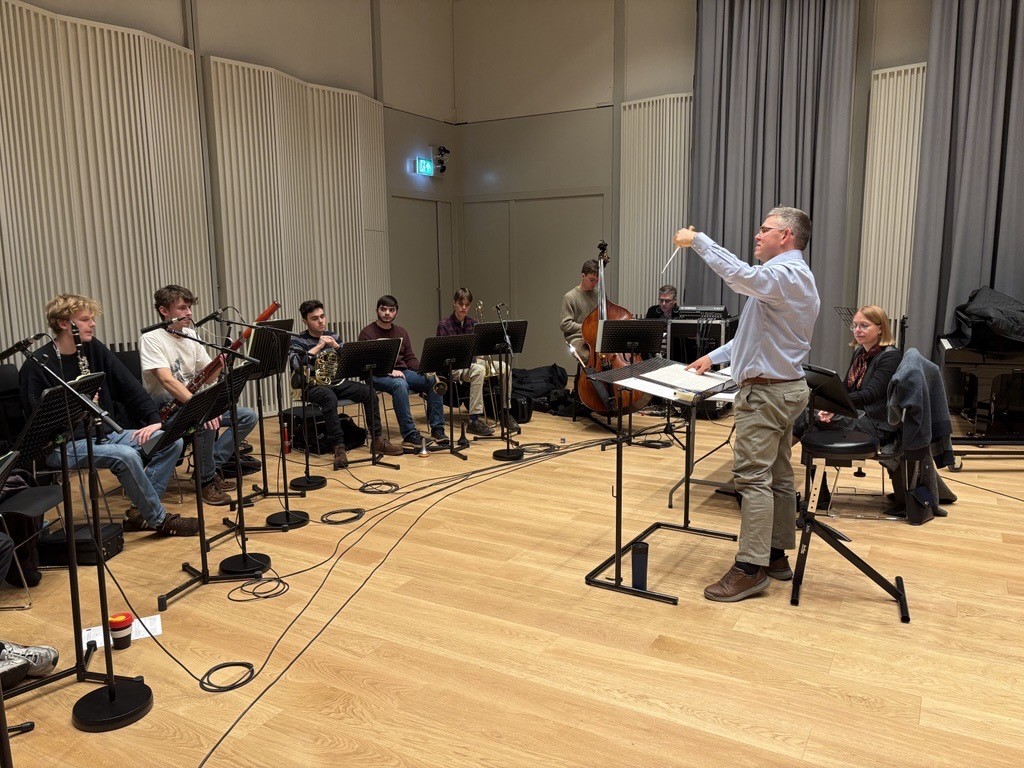
Experimenting with sound: student musicians from the Faculty of Music, Professor John Traill, Jody Elff and Anna Clyne working together in the Schwarzman Centre's Recital Hall
You’ve spent time working closely with student musicians here at the Schwarzman Centre. What has the collaborative process been like?
Jody: It’s been great to have an ensemble of student musicians here at the Schwarzman Centre to try out some of these processes. Working in isolation and speculating about the nature of the piece only gets you so far, and the processes behave differently when you’re working with live players.
The students’ enthusiasm for collaboration has been fantastic and has allowed us to try out augmentation processes with real players in real time. Sometimes we discover that our intention was spot on, and sometimes it requires a little adjustment. Having the opportunity to do that here has been incredibly valuable.
To finish, how would you each describe your work in three words?
Jody: Expansive, immersive, thought-provoking.
Anna: Experimental, layered, fun!
Join us on Wednesday 24 June for the premiere performance of Looking Glass in the Sohmen Concert Hall. Book tickets
Anna Clyne: Looking Glass
Dvořák, Stravinsky, Copland and Clyne: American Chamber Music
Read more